
Rental Property Maintenance Checklist: A Landlord's Guide
Once a tenant has moved in and rent is coming in on schedule, the day-to-day work of owning a rental property shifts. Rent collection protects your cash flow. Maintenance protects the physical asset that generates it — and it shapes how your tenant experiences living there every single day. A dripping faucet ignored for six months can become a subfloor repair. A furnace that's never serviced can fail on the coldest week of the year, right when a service call is hardest to schedule.
This guide is built around one idea: maintenance works best as a system, not a reaction to whatever breaks next. A system means you know what needs checking, roughly when it needs checking, who's responsible for handling it, and where the record of what happened lives. That's a very different experience than the common alternative — something breaks, and now you're scrambling to find someone who can fix it today.
A few things worth being upfront about. Maintenance needs vary enormously by property age, climate, equipment, and history, so this guide gives you frameworks and ranges rather than one-size-fits-all rules. It's also not a substitute for your lease or for local law — always check both for anything jurisdiction-specific. And no maintenance schedule eliminates surprises entirely; the goal is fewer of them, and smaller ones when they happen.
What Is a Rental Property Maintenance Checklist?
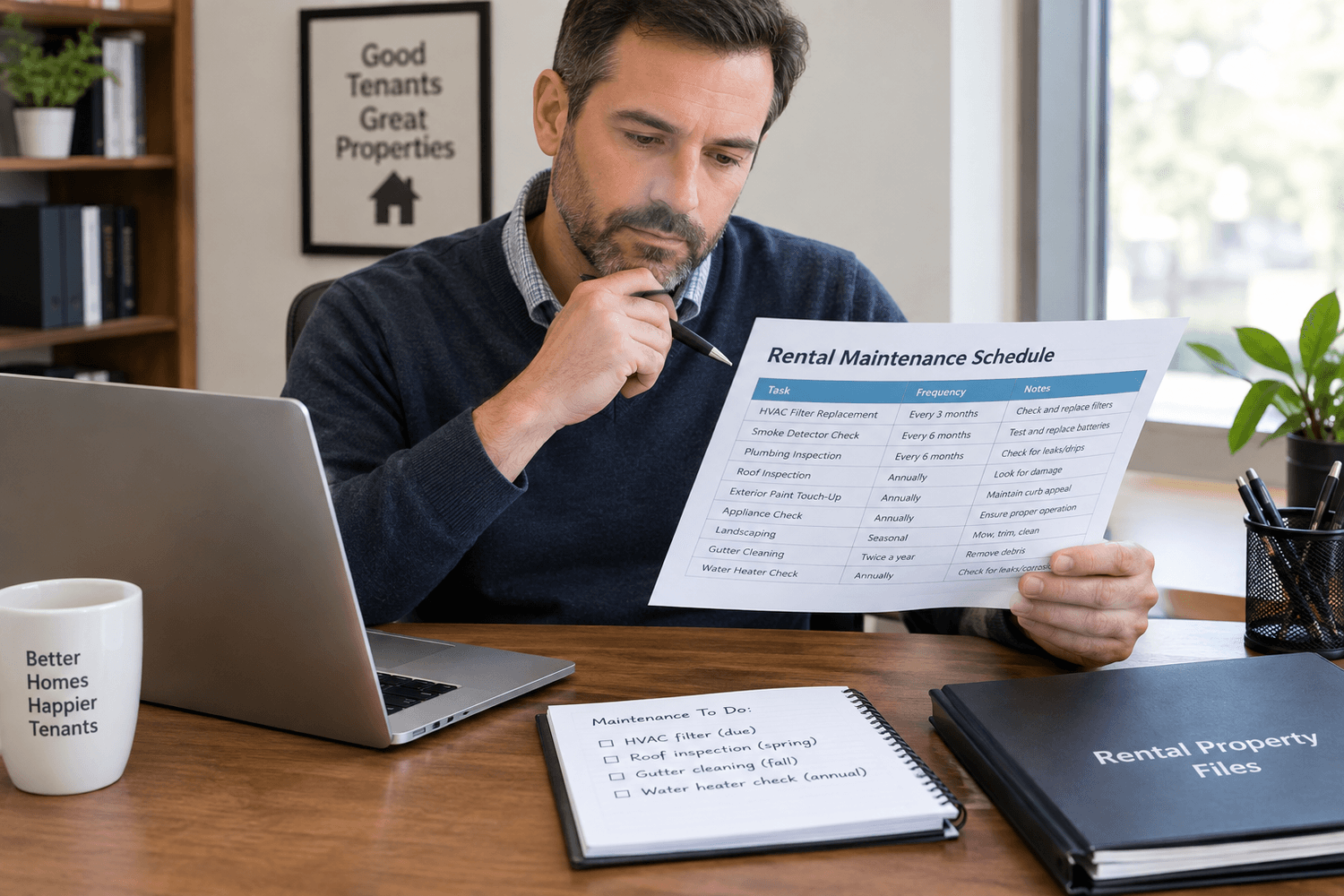
A rental property maintenance checklist is a recurring system for checking, servicing, cleaning, repairing, replacing, and documenting the condition and function of a rental property throughout a tenancy. It's less a single document than an ongoing habit, built around four kinds of work:
Preventive maintenance is work done to reduce the likelihood of a failure before it happens — replacing a water heater's anode rod, servicing HVAC equipment, or resealing exterior caulking before winter.
Reactive maintenance is work performed after a problem has already occurred — a clogged drain, a dead light fixture, a broken appliance.
Emergency maintenance covers issues that need an urgent response because of safety, habitability, or the risk of major property damage — active flooding, no heat in freezing conditions, an electrical hazard, a gas smell.
Routine upkeep is the recurring, lower-stakes work that keeps a property presentable and functioning: cleaning common areas, replacing air filters, checking exterior lighting.
Most rental properties need all four categories running at once. The goal of a checklist isn't to eliminate reactive and emergency maintenance entirely — that's not realistic — but to shrink how often they happen by catching problems while they're still preventive-maintenance-sized.
Why Rental Property Maintenance Matters
Maintenance protects the physical property itself: roofs, plumbing, electrical systems, and major appliances all degrade faster when small issues are ignored. It also reduces avoidable deterioration and helps you catch developing problems — a slow leak, a failing seal — while they're still cheap fixes rather than expensive ones.
Beyond the property, consistent maintenance supports the tenant's day-to-day experience and reduces the disruption that comes from things breaking unexpectedly. It gives you a documented service history, which matters for warranties, for understanding what's actually happening with your property systems over time, and for basic organization if you ever need to reference when something was last serviced.
What maintenance doesn't do is guarantee outcomes. A well-maintained property isn't guaranteed a higher rent, guaranteed tenant renewal, lower insurance premiums, or zero emergencies. It shifts the odds in a useful direction — fewer surprises, smaller ones when they happen — without eliminating risk.
The Four Maintenance Clocks
A useful way to organize rental maintenance is to think in terms of four overlapping schedules, each running at its own pace:
Monthly — quick, low-effort checks and a review of any open tenant requests.
Quarterly — a somewhat deeper look at systems and areas that don't need monthly attention but shouldn't go a full year unchecked.
Seasonal — tasks tied to weather and climate, timed around the season ahead rather than the calendar month.
Annual — professional servicing, larger system reviews, and planning for anything that needs replacing in the next year or two.
One important caveat: no property needs the exact same schedule as every other property. Frequency depends on the property's age, your local climate, the specific equipment installed, manufacturer recommendations for that equipment, the property type, what your lease says about who's responsible for what, and the property's own maintenance history. Treat everything below as a starting framework to adapt, not a fixed formula.
Rental Property Maintenance Checklist at a Glance
| Frequency | Main Areas | Typical Tasks | Record to Keep |
|---|---|---|---|
| Monthly | Plumbing, HVAC, safety, exterior, tenant requests | Visual checks, request review, obvious hazard scan | Updated request log, notes on anything flagged |
| Quarterly | Plumbing, HVAC filters, appliances, exterior, doors/windows/locks | Deeper visual review, minor servicing | Quarterly review notes, any work completed |
| Seasonal | HVAC prep, drainage/gutters, exterior, landscaping | Weather-readiness tasks specific to the season | Seasonal task completion dates |
| Annual | All major systems, safety equipment, warranties | Professional servicing, major system review | Full annual service record, updated warranty list |
| Tenant-reported / as-needed | Whatever the tenant flags | Triage, assign, resolve, confirm | Request date, resolution, vendor, cost |
| Turnover-related | Whole property | Handled separately at move-out | See the site's move-in documentation for the starting-condition reference point |
This table covers ongoing maintenance only — it's distinct from the property's starting-condition documentation, which is covered on this site's move-in checklist rather than repeated here.
Monthly Rental Property Maintenance Checklist
Monthly maintenance is meant to be quick — a short, consistent scan rather than a deep inspection.
Plumbing: Look for signs of visible leaks, unexplained moisture, slow drains, or recurring water issues the tenant may have mentioned.
HVAC: Where filter changes fall under landlord responsibility, check filter condition. Note any performance issues, unusual noises, or thermostat complaints that have come up.
Safety: Stay alert to any reported alarm issues, blocked exits, or visible hazards raised by the tenant or noticed during any lawful, notified visit to the property.
Exterior: Watch for obvious damage, drainage problems, non-functioning exterior lighting, or overgrown vegetation affecting access or visibility.
Tenant maintenance requests: This is arguably the most valuable monthly task. Review open requests, anything recurring, repeated failures of the same fixture or system, and vendor work that's still pending.
A note worth being explicit about: this checklist doesn't assume monthly physical entry into an occupied unit. Property access is governed by your lease and by applicable law, which generally require proper notice except in genuine emergencies. Most of this monthly review can happen through tenant communication and your own records, not a physical walkthrough.
Quarterly Maintenance Checklist
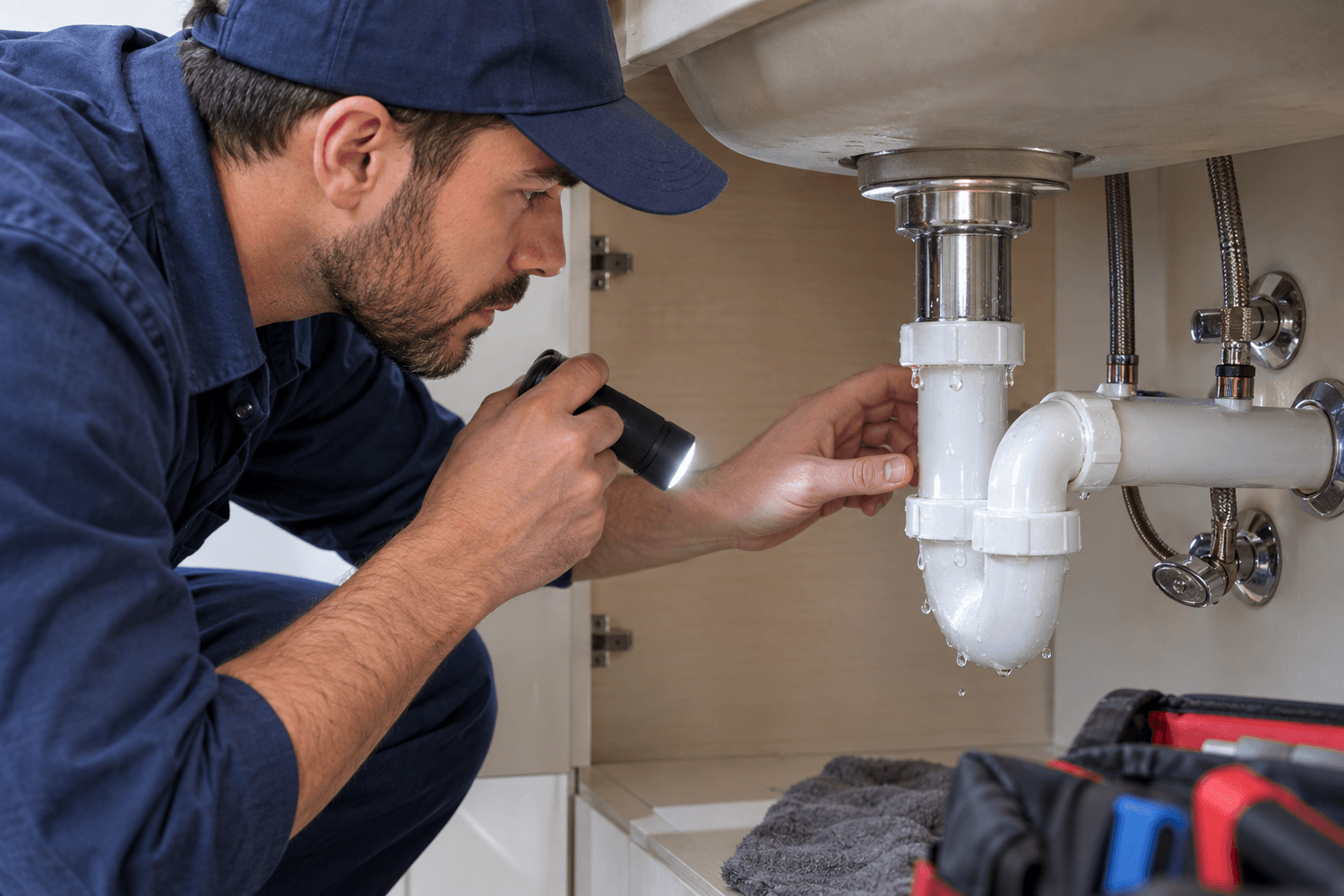
Quarterly maintenance goes a layer deeper than the monthly scan:
Plumbing fixtures and visible pipe condition
Caulking and grout in wet areas (showers, tubs, sinks)
HVAC filter replacement and a basic performance check
Appliance condition and function
Exterior condition and drainage
Doors, windows, and locks — confirming they open, close, and secure properly
Any visible signs of pests or moisture
Common-area systems, where the property has them
Treat this as a general framework rather than a legal requirement — it's a practical rhythm, not a mandated inspection schedule.
Seasonal Maintenance Checklist
Seasonal maintenance is about preparing for the season ahead, not just reacting to the one that just ended. Exact tasks depend heavily on your climate — treat every item below as "where applicable."
Spring
Check for any damage from winter weather
Review drainage and gutters where applicable
Prepare HVAC for warmer weather ahead
General exterior review after a season of weather exposure
Landscaping preparation, where relevant
Summer
Confirm cooling-system performance
Check for exterior wear from sun and heat exposure
Watch for pest activity, which often increases seasonally
Review irrigation systems where applicable
Confirm drainage is handling any seasonal storms
Fall
Prepare heating systems ahead of colder weather
Clean gutters before leaf drop is complete
Check weather sealing around doors and windows
General winter-preparation review
Winter
In climates where freezing is a risk, take freeze-prevention precautions (insulating exposed pipes, for example)
Confirm heating systems are functioning reliably
Stay alert to weather-related hazards (ice, snow load, downed branches)
Confirm you have a plan for responding to winter emergencies
Climate-specific tasks are not universal — a freeze-prevention step that matters in a cold climate may be irrelevant where you own property, and vice versa.
Annual Rental Property Maintenance Checklist
Annual maintenance is where the bigger, often professional-level work happens:
HVAC professional servicing, where recommended for your specific equipment
A broader plumbing and system review
Electrical review where appropriate, especially for older properties
Roof and exterior assessment
Water heater maintenance according to manufacturer guidance and the unit's age and condition
Appliance condition review
Smoke and carbon-monoxide equipment check
Locks and security hardware review
Drainage system review
Landscaping review
Pest-prevention measures
Reviewing warranties on major equipment before they lapse
Consolidating the year's vendor and service records
Where a task genuinely calls for a qualified professional — gas equipment, electrical panels, major plumbing, roofing — say so plainly rather than treating it as a DIY item.
Room-by-Room / System-by-System Checklist
| Area/System | What to Watch For | Typical Maintenance Action | When to Escalate |
|---|---|---|---|
| Roof and exterior | Missing shingles, visible wear, staining | Schedule professional assessment | Any sign of active leaking |
| Gutters/drainage | Clogging, sagging, water pooling near foundation | Clean and clear on a seasonal basis | Water intrusion or foundation concerns |
| Doors/windows/locks | Sticking, drafts, loose hardware | Adjust, lubricate, tighten hardware | Lock failure or security concern |
| Plumbing | Slow drains, drips, water stains | Clear minor clogs, tighten fittings | Any active leak or water damage |
| Electrical | Flickering lights, warm outlets, tripped breakers repeatedly | Replace bulbs/fixtures as needed | Any burning smell, sparking, or repeated breaker trips — treat as urgent |
| HVAC | Weak airflow, unusual noise, inconsistent temperature | Filter changes, basic cleaning | Complete failure, especially in extreme weather |
| Water heater | Rust-colored water, unusual noise, inconsistent temperature | Manufacturer-recommended maintenance | Leaking tank or no hot water |
| Kitchen appliances | Poor seals, unusual noise, leaks | Clean, adjust, minor repair | Gas smell, electrical issue, or repeated failure |
| Bathroom fixtures | Deteriorating caulk/grout, slow drains | Reseal, clear minor clogs | Water damage behind walls or under flooring |
| Laundry | Vent lint buildup, hose wear | Clean vent, inspect hoses | Any sign of fire risk from lint buildup |
| Floors/walls/ceilings | Cracks, staining, soft spots | Monitor, document, minor repair | Water staining suggesting a hidden leak |
| Smoke/CO alarms | Chirping, failure to test successfully | Replace batteries, test units | Any unit that fails to test |
| Yard/exterior areas | Overgrowth, tripping hazards, drainage issues | Routine upkeep per lease responsibility | Structural or safety hazards |
| Garage/storage | Door function, lighting, pest signs | Basic servicing | Door safety-sensor failure |
This table focuses on ongoing maintenance signals and actions, not on documenting a property's initial condition — that's a separate process covered elsewhere on this site.
Tenant Maintenance Requests
This is where a lot of the day-to-day maintenance workload actually lives, and it benefits from a consistent process:
Tenant reports a problem.
Landlord records the request — date, description, and how it was reported.
Determine urgency — is this emergency, urgent, or routine?
Gather useful information, including photos where that's practical and appropriate.
Decide whether basic troubleshooting is reasonable before dispatching a vendor.
Assign responsibility based on the lease and applicable rules — landlord, tenant, or vendor.
Schedule the work.
Confirm completion with the tenant.
Document the resolution — what was done, by whom, and when.
Watch for recurrence — a problem that keeps coming back usually points to something bigger than the surface-level fix addressed.
That last point is worth dwelling on. A tenant reporting the same clogged drain three times in six months isn't necessarily being difficult — it's often a signal of a pipe issue further along the line, not just a one-time blockage. Recurring requests are one of the best early-warning systems a landlord has if they're actually tracked instead of handled individually each time.
Emergency vs. Routine Maintenance
| Situation | General Priority | Typical Response |
|---|---|---|
| Active major water leak | Urgent | Immediate response |
| Loss of essential service (heat, water) | Potentially urgent | Assess promptly |
| Electrical burning smell or smoke | Emergency | Treat as a safety issue |
| Broken appliance with no safety issue | Routine | Schedule appropriately |
| Cosmetic issue | Low priority | Schedule when practical |
This table is a general planning tool, not a universal legal standard. What counts as an emergency, and how quickly a landlord is legally required to respond, varies by jurisdiction and by the specific circumstances. If there's immediate danger — gas smell, active fire risk, electrical hazard — the right first step is contacting emergency services or a licensed professional, not attempting a DIY fix.
When Should a Landlord DIY vs. Hire a Professional?
Reasonable routine tasks a landlord (or a handy tenant, where the lease allows) might handle directly:
Simple filter replacements, where that's the landlord's responsibility
Basic cleaning and light maintenance
Documenting issues thoroughly
Replacing ordinary consumables (light bulbs, smoke-alarm batteries) where it's safe and permitted
Professional territory — work that generally calls for a licensed or qualified professional:
Electrical work
Gas-system work
Major plumbing repairs
Structural work
Roofing
Major HVAC repair
Anything requiring a permit or license in your jurisdiction
Not every task legally requires a licensed professional everywhere — requirements vary significantly by location. The decision should weigh safety, your actual skill level, whether you have the right tools, permit requirements, how the work affects any equipment warranty, and your own liability exposure if something goes wrong.
Maintenance Records
Good maintenance records pay off in ways that aren't obvious until you need them: tracking recurring problems, supporting warranty claims, building a vendor history, budgeting for the year ahead, and having documentation ready if it's ever needed for insurance purposes.
| Date | Property/Unit | Issue or Task | Action Taken | Vendor | Cost | Next Due | Notes |
|---|---|---|---|---|---|---|---|
| 2024-04-27 | Unit 101 | Leaking faucet | Replaced washer | Plumbing Co. | $75 | 2024-05-27 | Check for leaks after one month |
If you're tracking maintenance costs for tax purposes, keep in mind that repairs and improvements are typically treated differently — a repair that restores something to its prior condition is usually handled differently than a capital improvement that adds value or extends useful life. This distinction has real tax consequences, so work with a qualified tax professional or authoritative tax-agency guidance rather than assuming a repair and an upgrade are interchangeable for recordkeeping purposes.
Build a Maintenance Calendar
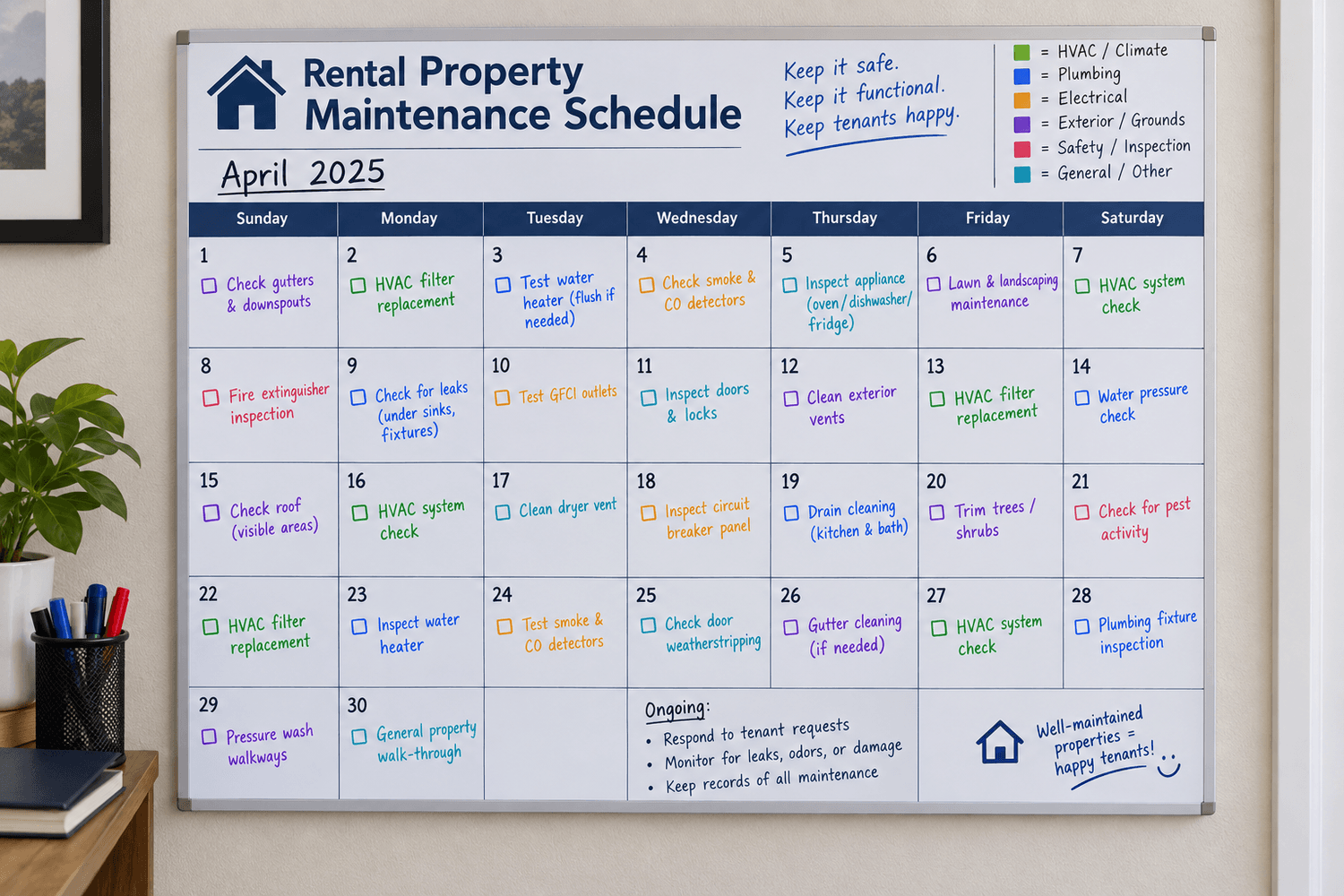
A simple maintenance calendar turns the checklists above into something you'll actually follow. Useful fields to track:
Property
System or area
Task
Frequency
Responsible person
Last completed
Next due
Vendor
Cost
Notes
You can build this in a spreadsheet, a shared calendar with recurring reminders, or dedicated property-management software. The tool matters far less than the habit of actually updating it — a beautifully built calendar nobody checks isn't meaningfully different from having no system at all.
How to Handle Maintenance Costs
Maintenance spending generally falls into a few buckets: planned routine maintenance, emergency repairs, recurring professional servicing, and larger planned replacements as equipment ages. Getting vendor quotes for anything beyond minor work, tracking warranties so you're not paying for something still covered, and keeping clear records all help keep costs predictable rather than surprising.
One optional way to think about budgeting, offered as a planning example rather than a financial rule: routine maintenance budget + a reserve for unexpected repairs + planned capital replacements. There's no universal "correct" reserve percentage that applies to every property — older properties and properties with aging major systems typically need more planning around anticipated replacements than newer ones.
Common Landlord Maintenance Mistakes
Waiting until something breaks instead of checking on a schedule
Relying on memory instead of a written system
Failing to document completed work
Ignoring a tenant's recurring complaint about the same issue
Using unqualified help for specialized work that needs a licensed professional
Ignoring manufacturer maintenance guidance for major equipment
Losing track of warranties that could have covered a repair
Treating every issue as an emergency, which burns out your time and goodwill
Treating a genuine emergency as routine, which creates real risk
Going quiet with tenants instead of communicating about maintenance timelines
Mixing maintenance records across multiple properties into one undifferentiated pile
Forgetting seasonal preparation until the season is already underway
Focusing only on the interior and neglecting exterior or drainage issues
Entering an occupied unit without following proper notice procedures
Master Rental Property Maintenance Checklist
Monthly
☐ Review open maintenance requests
☐ Review recurring issues
☐ Check relevant systems and tasks based on the property's specific needs
☐ Review any reported leaks or moisture concerns
☐ Review exterior concerns
☐ Update maintenance records
Quarterly
☐ Review HVAC/filter needs
☐ Review plumbing concerns
☐ Review wet-area caulking and grout
☐ Review exterior and drainage
☐ Review appliances
☐ Review doors, windows, and locks
☐ Review safety-related concerns
Seasonal
☐ Prepare HVAC for the upcoming season
☐ Check weather-related risks
☐ Review drainage and gutters where applicable
☐ Prepare outdoor systems
☐ Address climate-specific risks
Annual
☐ Review major systems
☐ Schedule appropriate professional servicing
☐ Review warranties
☐ Review the year's repair history
☐ Review maintenance records
☐ Plan major replacements where needed
When a tenant reports a problem
☐ Record the request
☐ Determine urgency
☐ Check the lease for responsibility
☐ Confirm applicable local requirements
☐ Arrange an appropriate response
☐ Document the work
☐ Confirm completion
☐ Watch for recurrence
Maintenance vs. Inspection
Maintenance and inspection get used interchangeably, but they're different jobs:
| Aspect | Maintenance | Inspection |
|---|---|---|
| Purpose | Keeps systems functioning | Checks condition |
| Includes | Includes repairs and servicing | Identifies issues |
| Type | Can be preventive or reactive | Primarily observational |
| Timing | Happens according to system needs | Happens on a lawful, practical schedule |
| Records | Produces service and repair records | Produces condition observations |
They support each other — an inspection often surfaces what maintenance needs to address — but they're not the same activity, and this guide is intentionally focused on the maintenance side rather than becoming a full property-inspection guide.
Legal and Safety Requirements
This is a landlord-facing, legal-adjacent topic, so the distinction between general best practice and a legally required responsibility matters. This guide does not claim that every landlord must inspect monthly, that every landlord must replace filters on a fixed 30-day cycle, that HVAC servicing twice a year is universally required, that every property must include a specific appliance, or that repair-response deadlines are identical everywhere. None of that is true across jurisdictions.
What is true broadly: habitability standards, safety-equipment requirements, and repair-response expectations exist in most places in some form, but the specifics vary and change over time. For anything jurisdiction-specific, check your state or local housing authority, your local building or fire-safety authority, and official municipal guidance — and treat manufacturer documentation for equipment maintenance as separate from legal requirements, since a manufacturer's recommended interval isn't automatically a legal mandate.
Property Access and Tenant Privacy
Maintenance often requires entering an occupied property, and that needs to be handled carefully. In general: landlords typically need some ability to access the property to perform maintenance, tenants generally have privacy rights in their home, notice requirements for non-emergency entry vary by location, emergency-entry rules are usually different from routine-entry rules, and both your lease and local law matter here. There's no universal notice period (for example, a fixed "24 hours") that applies everywhere — confirm the current rule for your property's specific location before relying on any particular number.
Manufacturer Recommendations
For equipment like HVAC systems, water heaters, and major appliances, maintenance intervals often depend on the specific manufacturer's guidance, the model, its age, the conditions it's operating under, and how heavily it's used. There's no single universal interval that applies to every unit of a given type. Where you're following a specific technical maintenance schedule, check it against the manufacturer's documentation or another reputable, current source rather than a generic rule of thumb.
FAQ Section
It depends on the task. Monthly reviews of tenant requests and obvious issues, quarterly checks of systems like plumbing and HVAC, seasonal preparation tied to weather, and annual professional servicing of major systems is a reasonable general framework — but exact frequency depends on your property's age, climate, and equipment.
Preventive maintenance is done to reduce the chance of a failure before it happens — like servicing HVAC equipment on a schedule. Reactive maintenance happens after something has already gone wrong. Most rental properties need a mix of both.
It depends on the lease and applicable local law. Generally, landlords handle major systems and structural items, while tenants handle day-to-day upkeep like light bulb replacement — but this split should be spelled out explicitly in the lease rather than assumed.
Record the request, assess urgency, check who's responsible under the lease, arrange an appropriate response, document what was done, and watch for whether the same issue recurs.
It's strongly recommended even where not strictly required. Records help track recurring problems, support warranty claims, assist with budgeting, and provide documentation if it's ever needed for insurance or tax purposes.
Maintenance is the work of keeping systems functioning — repairs, servicing, replacement. Inspection is the act of checking a property's condition. They support each other, but they're separate activities.
For anything involving electrical work, gas systems, major plumbing, structural repairs, roofing, or major HVAC work — and for anything requiring a permit or license where the property is located. Basic tasks like filter changes or light bulb replacement are usually reasonable to handle directly.
No. Property access is governed by the lease and applicable local law, which generally require proper notice except in genuine emergencies. Most monthly maintenance review can be done through tenant communication and records rather than routine physical entry.